Amerykahn Graffiti
Sunday, March 1, 2026, 3PM
Waetjen Auditorium
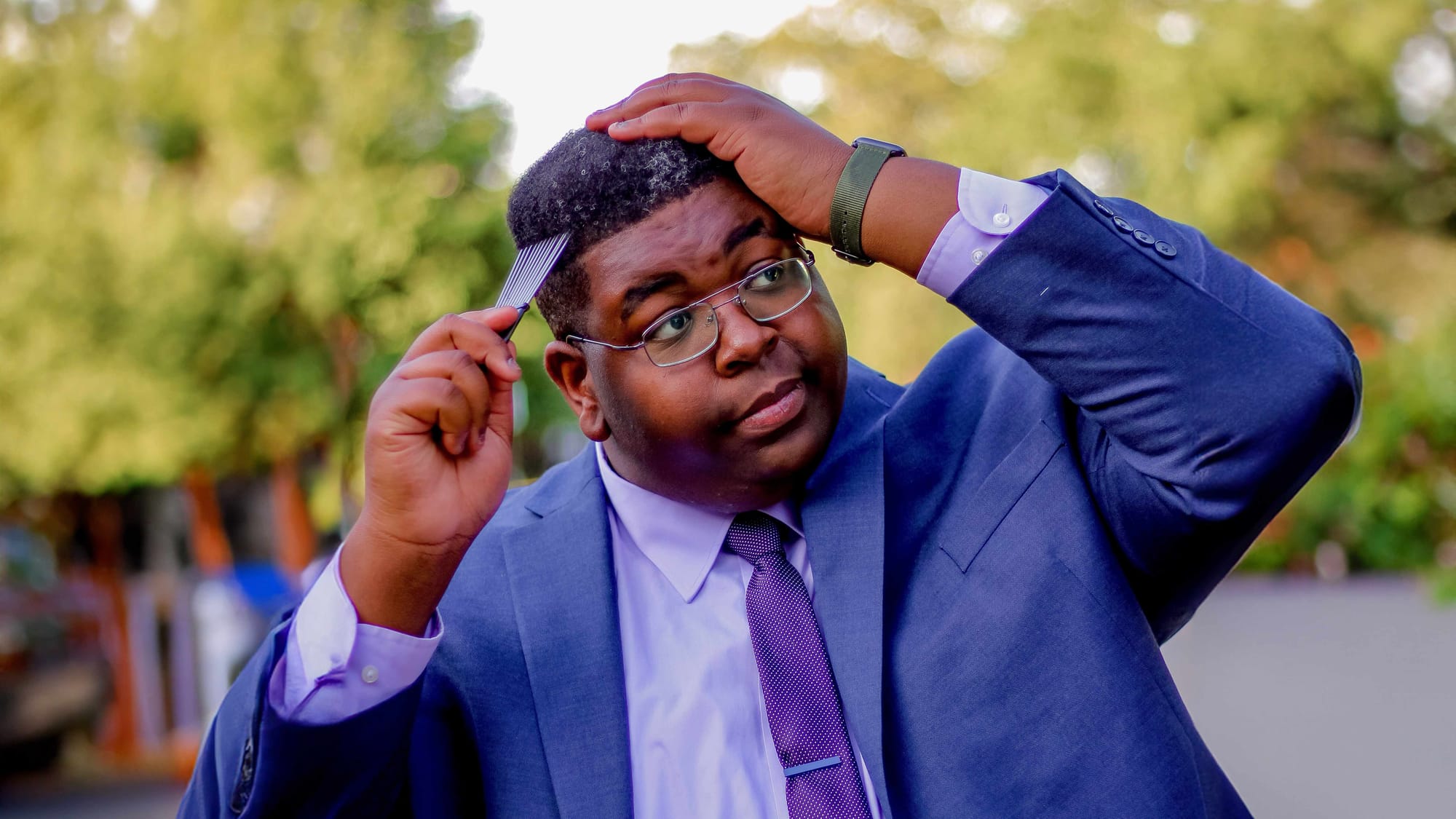
In collaboration with the CSU School of Music and the Cleveland Youth Wind Symphonies, the Cleveland Winds is honored to be part of a four-day residency by composer Katahj Copley.
Georgia native Katahj Copley (he/him/his) premiered his first work, Spectra, in 2017 and hasn’t stopped composing since. As of now, Katahj has written over 100 works, including pieces for chamber ensembles, wind ensembles, and orchestra. His compositions have been performed and commissioned by universities, organizations, and professional ensembles, including the Cavaliers Brass, California Band Director Association, Admiral Launch Duo, and “The President’s Own” Marine Band. Katahj has also received critical acclaim internationally with pieces being performed in Canada, the United Kingdom, Japan, China, and Australia.
Katahj received two Bachelor of Music degrees from the University of West Georgia in Music Education and Composition in 2021. In 2023, he received his Masters in Music Composition from the University of Texas at Austin - studying with Omar Thomas and Yevgeniy Sharlat. He is currently studying music composition at Michigan State University.
Aside from composing, Katahj is an excited educator who teaches young musicians the joy of discovering music and why music is a phenomenal language.
“Music for me has always been this impactful thing in my life. It can soothe, it can enrage, it can quiet, and it can evoke emotions that are beyond me and this world we live in. I believe that music is the ultimate source of freedom and imagination. The most freedom I have had as a musician was through composing. Composition is like me opening my heart and showing the world my drive, my passion, and my soul.”
The two ensembles on this afternoon's performance have each had two rehearsals with Mr. Copley, and we're honored to perform his compositions for you this afternoon.
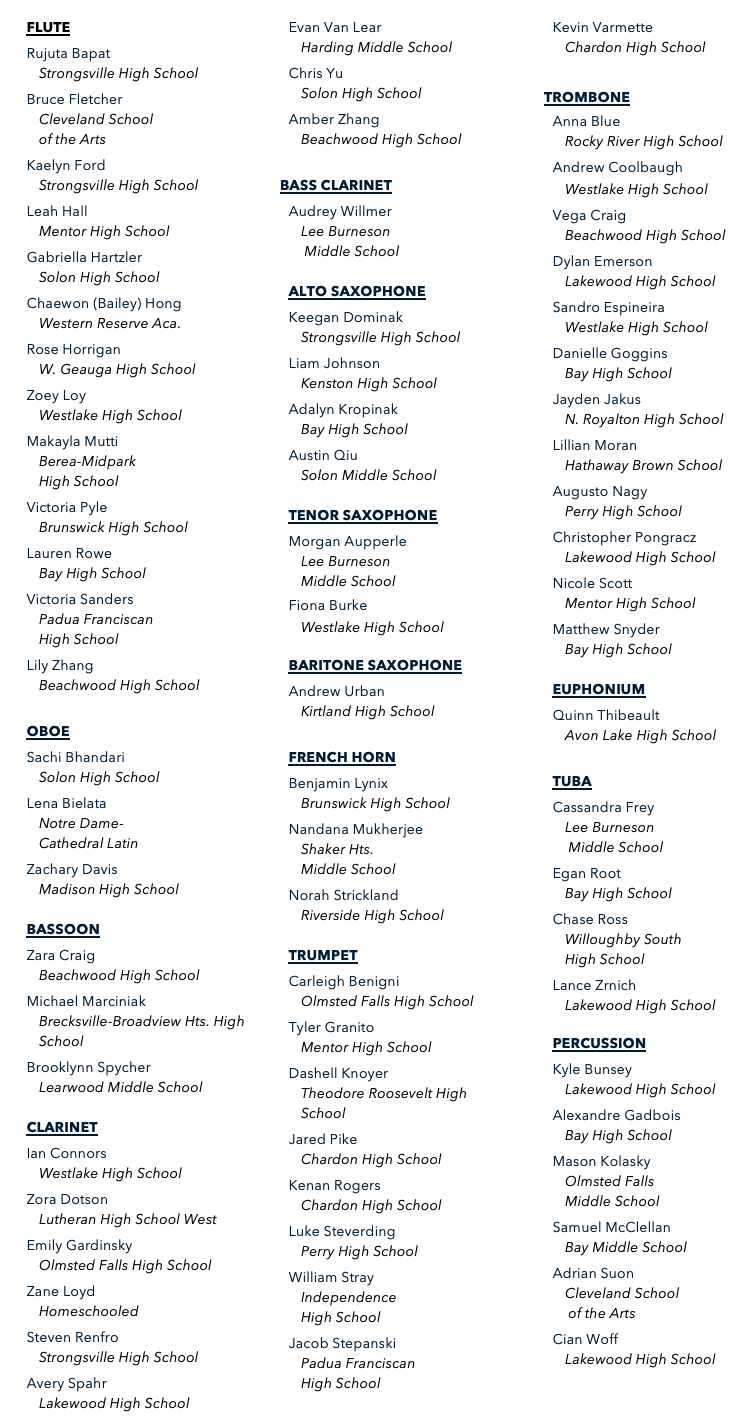
CLEVELAND YOUTH WIND SYMPHONY (CYWS) GROUP II
MARK AWAD and MICHAEL KOMPERDA, DIRECTORS
CYWS was founded in 1989 by Dr. Gary M. Ciepluch and Robert McAllister and is now in its 36th season. 1995-96 marked the initial season for the CYWS Group II under the direction of Melissa Lichtler. Originally brought about by a partnership between Case Western Reserve University School of Music and the Cleveland Institute of Music, the program was established to provide a musical venue for the most outstanding high school woodwind, brass, and percussion musicians throughout Northeast Ohio.
Selection in the Cleveland Youth Wind Symphony is determined through auditions held each May for the following fall. In partnership with Cleveland State University, CYWS holds weekly rehearsals at CSU’s School of Music in downtown Cleveland. In addition to the concerts they perform each season in Severance Music Center, the home of the world renowned Cleveland Orchestra, the groups have performed numerous times at conventions and festivals, and in concert halls throughout the United States and abroad. CYWS Group I has performed 10 times at the Ohio Music Education Association state convention, most recently in Columbus in February 2023. In 1992, the Cleveland Youth Wind Symphony was invited to perform at the Music Educators National Conference held in New Orleans, Louisiana.
In June 1994, the group began a series of international concert tours. They have performed in countries including Germany, the Czech Republic, Denmark, Norway, Sweden, Switzerland, Italy, Australia, New Zealand, Scotland, England, Ireland, France, Spain, Portugal, Poland, Hungary, Luxembourg, Austria, and the Netherlands. In 2018 CYWS was invited to perform as a headline group for the Florence, Italy, Festival of Youth Orchestras. CYWS’s 2023 tour of the United Kingdom included a performance with the Band of His Majesty’s Royal Marines—Scotland. In Summer 2025, CYWS toured Spain and reconnected with composer Luis Alarcón.
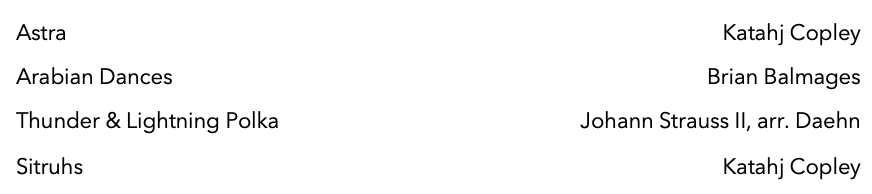
PROGRAM
CONDUCTOR BIOGRAPHIES
Mark Awad (he/him) Mark Awad is currently in his 20th year as director of bands at Bay Middle School. At the middle school, he teaches band in grades five through eight, in addition to the middle school jazz band. Mr. Awad is also the assistant director of the Bay High Rocket Marching Band. Additionally, he is the director of the pit orchestra for the musicals at Bay High School. Some of the musicals that he has conducted include: 42nd Street, Beauty and the Beast, The Addams Family, Chicago: High School Edition, Newsies, Something Rotten!, and The Music Man. Mr. Awad has also served as the chairperson for the Ohio Music Education Association, District 4 Middle School Honors Festival. Mr. Awad is also a member of the American School Band Directors Association. Mr. Awad earned his master’s degree in music education from Case Western Reserve University. He earned his bachelor’s degree in music education from Youngstown State University. His primary instrument is the trombone, on which he continues to perform.
Michael Komperda (he/him) is an alumnus of CYWS and a graduate of the Indiana University Jacobs School of Music where he earned his Bachelor of Music Education degree. Currently in his 17th year teaching, Mr. Komperda teaches in Rocky River, where he directs the Marching Band, Wind Ensemble, two high school Jazz Bands, the Pit Orchestra and the Pep Band, and teaches Music Technology and AP Music Theory courses at Rocky River High School. He also teaches beginning Brass & Percussion and third grade music at Kensington Intermediate School. Outside of his teaching duties, Mr. Komperda plays clarinet in the Cleveland Winds, and directs and plays in pit orchestras around the Cleveland area. Recently, he has performed in productions of 9 to 5, Matilda the Musical, Sweeney Todd, Into the Woods, Beauty and the Beast, and Young Frankenstein. Professionally, Mr. Komperda is a member of the American School Band Directors Association (ASBDA), the Ohio Music Education Association, and the Greater Cleveland Solo & Ensemble Association.
INSTRUMENTAL COACHES
Hailey Bryson
Tim Carlson
Robert Davis
Tess Hosler
Andrew Pongracz
Nicholas Strawn
STUDENT INSTRUMENT COACHES
Miya DeBolt
Kira Marjanovic
PERCUSSION EQUIPMENT ASSISTANT
Gabe Scott
STUDENT VOLUNTEER COACH
Regan Pontius
SYMPHONY MANAGER
Alice Moore Allen
CO-MUSIC DIRECTORS
Darren Allen
Mark Awad
Daniel Crain
Michael Komperda

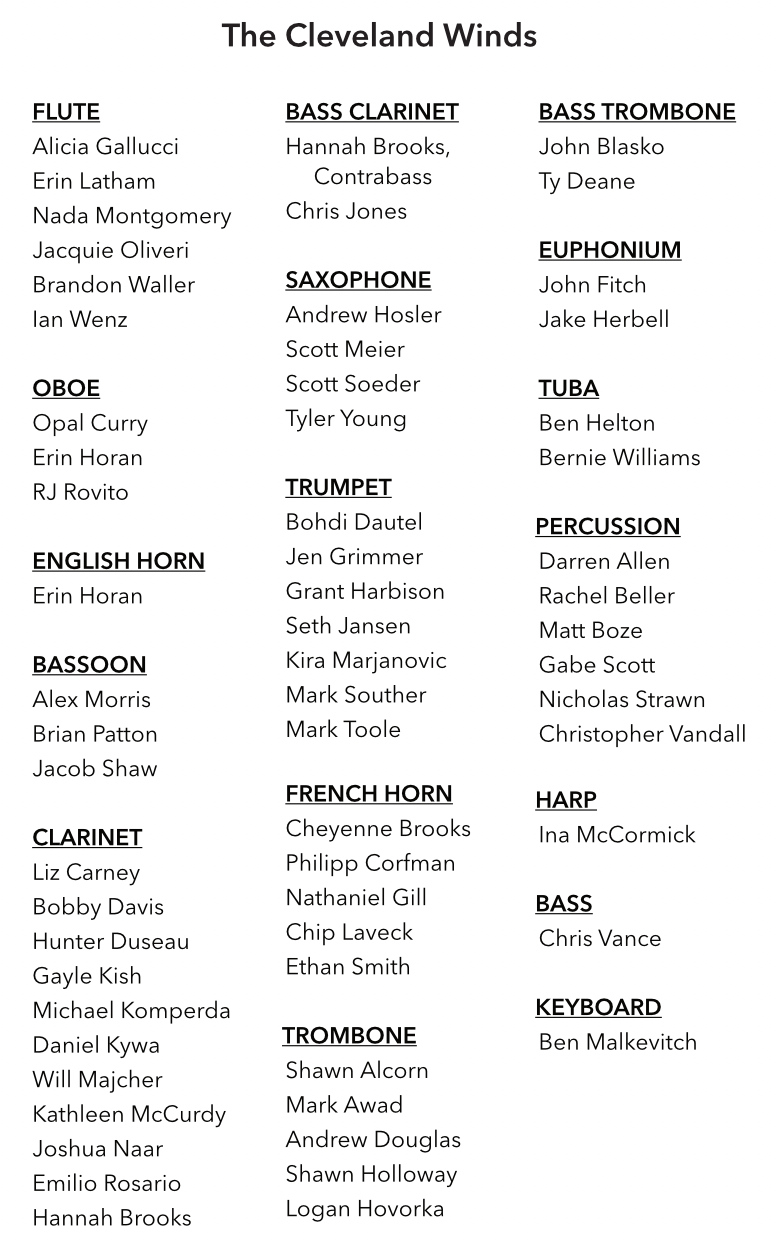
THE CLEVELAND WINDS
Dr. Birch Browning, Music Director
The mission of Cleveland Winds is to perform diverse and challenging wind band repertoire, from masterworks to innovative contemporary compositions, providing a unique and inspiring musical outlet for professional, student, and advanced non-professional musicians. We are committed to fostering a collaborative and growth-oriented environment for our members, enabling them to achieve musical excellence and share their passion. We serve the community by presenting accessible, high-caliber concerts that challenge perceptions of wind music, educate audiences, and inspire future musicians through the transformative power of live performance.
The Cleveland Winds is supported in part by the residents of Cuyahoga County through a public grant from Cuyahoga Arts and Culture. Please consider making a tax-deductable donation to support the mission of the Cleveland Winds at https://www.clevelandwinds.org/support/.
AMERYKAHN GRAFFITI
Graffiti can be war paint
It is a serenade of spray paint and brush strokes.
It is survival written in hue.
It is history in technicolor.
Graffiti has long stood at the crossroads of controversy and creativity. For some it is a sign of failure. A forecast of urban decay. But for others it is the truth—unfiltered, unapproved, and unbought. What others feared was the brilliance in the chaos, the power in color that never asked for permission to exist. Graffiti is not vandalism. It’s a conversation. It's an expression. It’s a voice that refuses to be silent.
For the artists, instead of being in society’s frame by being held within museums, they built their own—on trains, on walls, on canvases people tried to forget.
Amerykahn Graffiti is an homage to that gallery. It is the canvas. It is a sonic offering.
A reimagining of Mussorgsky’s Pictures at an Exhibition, painted in sound and soul, it is a journey through the Black experience—our joy, our wounds, our beauty, our rage. Each movement is a mural. Each sound, a heartbeat. Each note, a stitch in a story quilt.
It moves through the sounds once called “noise”—hip-hop, gospel, funk, jazz and other black music—sounds born in basements, communities and backstreets, now cornerstones in music creation. Like graffiti, these sounds were ridiculed, erased, feared. But they endured. They transformed. They became the soundtrack of the human soul.
This isn’t background music.
It’s a living, breathing, unapologetic portrait of a people who refuse to be silenced.
This is a tribute.
This is a love letter.
This is a cry.
This is a testimony
This is Amerykahn Graffiti.
PROMENADE
"Imagine you want to walk in the exhibition but they won't let you in"
The opening of this project. Similar to Mussorgsky's Pictures (Maurice Ravel's transcription) the work starts with an opening solo and from there the colors begin to blend into one another ultimately creating the framework of this project.
A feeling of oppression breaking with the hope of expression.
I. GOTHIKA
The Gnome by Mussorgsky illustrated a disgruntled figure not fitting of society's image. The original is fast, aggressive and intense. For me I wanted to highlight a group of individuals that were and to a certain extent like gnomes, African Americans in the blue collar work force. This movement is built as an intense hymn- based on "Black is the Color of My True Love's Hair". The movement is relentless and harsh with only a brief moment of relief. Dedicated to my father and to all the countless African Americans who worked their entire lives to make their dreams and others dreams happen.
II. LOVE IS AN OFFERING
While working on this piece, my initial goal was to align each movement closely—minute by minute—with Mussorgsky’s Pictures at an Exhibition. In this movement, however, I allowed myself to move away from that structure. Black love and unity hold profound power within the Black community, and with Kerry James Marshall’s Slow Dance as my visual inspiration, I wanted to give this idea space to breathe.
Like the painting, the music unfolds as a slow dance between two souls. The music builds off this riff, The Hope Theme, that is a prayer given to the two souls. As the world turns and its pressures accumulate, the couple continues to move together—remaining present, connected, and rooted in love through hardship and uncertainty. The title of the work comes from James Baldwin’s words: “If I love you, I have to make you conscious of the things that you do not see.” This movement reflects love as awareness, care, and shared growth. Dedicated to my partner and to all who feel this sentiment of love being a dance that isn’t bound to the rhythm of the world but to the rhythms of their hearts.
III. PLAYAS GARDEN
“The Tulleries” movement
With a Afro-Latin & Gospel blend, Playas Garden- based on Tony WHLGN's "Untitled"- is a response to children playing-imagining themselves as different things. Featuring only woodwinds and percussion, Playas Garden grows with intensity, colors, and technique. Similar to The Tulleries it is playful and lively.
IV. SARAH SEPHONIA, SWEET THING, & PEACHES
“The Bydlo” movement
The Bydlo movement depicts cattle moving a cart in a slow persistent way- its constant and unnerving. With my movement I was inspired by Tatyana Fazlalizadeh’s street art series Stop Telling Women to Smile, a powerful set of women murals about street harassment. I saw a version of this outside of the Hilton Hotel, a line of women with their natural emotion all the way down the street, constant and unnerving. The words “stop telling women to smile” being painted on the side of the long mural symbolized a persistent and powerful shout for change. This movement is based on the four women mentioned in Nina Simone’s Four Women and is dedicated to my mother, sisters, nieces, and all black women who have impacted me.
V. BALLET OF THE CROWNS
“The Ballet of the Unhatched Chicks” movement
This movement parallels Mussorgsky’s Ballet of the Unhatched Chicks. While studying the original costume sketches, I knew I wanted to draw inspiration from designs rooted in Black life and visual culture. I initially explored architecture and building forms, but the most immediate source revealed itself in a familiar ritual: getting a haircut.
In many Black barbershops, there hangs a worn, slightly blurry poster of hairstyles—Black men and boys serving as the models for these designs. Most are variations on a close cut or bald head, yet their presence carries weight. The Black barbershop and salon function as cornerstones of community development, especially for youth. They are loud, crowded, and chaotic spaces, but they are also sites of storytelling, debate, mentorship, and collective reflection.
This movement is an ode to that environment, translated through the language of bebop and Afro-Latin jazz—music that mirrors the energy, rhythm, and layered conversations of the shop itself.
VI. THE SILENCED COLORS
A silent movement, a memory of art erased by prejudice, classism, and the oppression of Black people across time. Imagine the melodies never sung, the chorales that might have risen, voices stilled before they could soar. What might have been, if only these sounds had lived?
VII. LADEE LIBATEE
“ Limoges. The Market” movement
Since its unveiling, Lady Liberty has stood as a beacon of hope, welcoming immigrants with the promise of new beginnings. Inspired by Sydney James’s The Girl with the D Earring, I imagined a city alive with color, movement, and voices—immigrants telling their stories on every corner, in every street.
This movement moves like the city itself: vibrant, layered, and full of conversation. Drawing from Tito Fuentes, Stevie Wonder, D’Angelo, and other global sounds, the music fuses styles and rhythms into a tapestry where everyone can find a place, a story, a heartbeat.
VIII. BREONNA
“ Catacombs” movement
This movement lives in a place that does not exist. Through this project, countless ideas and symbols emerged, one of the most persistent being the desire to turn back time—to offer someone a happy ending. A question came to mind when dealing with catacombs movement. How do you honor those that we’ve lost? Grief is an interesting concept in the culture; we celebrate those we’ve lost- we ask questions about what we could have done to help. IDuring this project, a thought resurfaced—one that had lingered with me for years but only fully took shape here: What if Breonna Taylor could sleep?
Breonna, based on the work by Amy Sherald is a lullaby dedicated to Breonna Taylor, a soul that lost her life to police brutality after officers forced entry into her home in Louisville, KY. The piece never reaches volume above a forte, to symbolize staying in this dreamworld, a world of peace and freedom. Constantly there's a feeling of uncertainty, knowing that the dream may come to an end at any moment. Eventually, we awaken, but traces of the dream linger, leaving behind a quiet, unresolved echo of what could have been.
IX. BOOGIEMAN
“ The Hut on Baba Yaga” movement
Mussorgsky’s Baba Yaga depicts a witch’s clock through fast, relentless motion, much like Gnomus. In Russian folklore, Baba Yaga exists between good and evil, though she is most often portrayed as monstrous—flying in a wooden mortar, wielding a pestle, and dwelling deep in the forest in a hut balanced on chicken legs.
This movement led me to consider how this figure appears across cultures. Within Black culture, Baba Yaga transforms into the boogeyman—a dark, ancestral presence used to warn, discipline, and protect, carrying fear as a form of survival. This reimagining is passed down through storytelling, sound, and memory.
My Boogieman- which is based off of two works by Jean-Michel Basquiat- draws from both Mussorgsky’s original work and this Black cultural lineage. He is a creature of dark soul, spiritually and musically rooted in the grittiest edges of funk—where groove, swagger, and danger coexist. This monster moves with charisma, a fear-eating, boogie-walking gangster shaped by rhythm and ancestral weight. The movement closes with a return of the promenade, as the darkest musical colors become saturated with sound, energy, and embodied power.
X. Soulstice
“ The Great Gates of Kiev” movement
This groundwork of this piece began with Alma Thomas’s work The Eclipse, a depiction of said event with every color working in harmony to bring the phenomenon to life so it was fitting that the work would be the ending of this project. When I saw the work in the Smithsonian I was amazed at the sheer beauty of the work.
For Mussorgsky’s Pictures, The Great Gate of Kiev rang the sounds of hope, community, and freedom. That is what I felt with Thomas’s work. Soulstice is the feeling of hope and promise within the black community. Using the opening of America the Beautiful as the groundwork of the piece, I wanted to capture a feeling of what hope could feel like- as if it was the sun peering from the horizon. The music builds and builds using the colors and themes of different movements to pay homage to every facet of black life I wanted to illustrate. There’s an understanding of struggle and hardship yet the music continues to build until the return of America the Beautiful. The piece ends with a prayer, similar to Love is an Offering, a prayer of peace and unity. Throughout this work I wanted to highlight black life and this last movement represented one thing that we all have in this community: resilience. As the prayer continues, the sound becomes stronger, the colors become bolder and the soul begins to rise. The prayer turns into a testimony.
Dr. Birch Browning is Professor of Music and Director of Bands at Cleveland State University (CSU) and Music Director of the Cleveland Winds, a professional wind band based at CSU. He taught high school band and orchestra in Florida prior to earning a Ph.D. in Music Education at Florida State University (FSU). Dr. Browning joined the faculty at CSU in 2002, and he previously taught music education courses at Stetson University and FSU.
Dr. Browning is a member of the College Band Director’s National Association Research Committee and has presented his research findings at numerous state and national conferences. His book, Becoming a Musician-Educator: An Orientation to Musical Pedagogy, was published by Oxford University Press in April 2017. Dr. Browning served on the editorial board of Contributions, a research journal sponsored by the Ohio Music Education Association (OMEA), from 2008 to 2020, including four years as Editor and six years as Associate Editor of the journal, and he is a current member of the College Band Director's National Association (CBDNA) Research Committee.
Along with his research work, Dr. Browning is in demand as a conductor and clinician. The Cleveland Winds, which Dr. Browning founded in 2009, is the winner of The American Prize in the Band/Wind Ensemble Performance—community & school division and performed at the Ohio Music Education Association Professional Development Conference in Cleveland, Ohio in 2017 and again in 2025. The CSU Chamber Winds performed at the same conference in 2005 and 2015. Dr. Browning’s ensembles have given live performances on WCLV, Cleveland’s Classical Music Station, on six occasions. The CSU Wind Ensemble, CSU Chamber Winds, and the Cleveland Winds appear on the Timothy Reynish International Repertoire Series, Vols. 12, 13, and 14 recordings, which are available on iTunes, Apple Music, Spotify, and other online sources.